Between the rocky Latin nightclubs of Paris and the aesthetic lights of dance parties in Marseille, one will find a cultural frenzy that moves to the beat of Bachata. Stepping inside any salsa or Latin social in France in recent past, you have probably been exposed by two variations of bachata coexisting at the same time—namely, Dominican Bachata and Sensual Bachata. The original, born in sunlit streets of the Dominican Republic; and the second, a more recent European translation that has now won a new audience.
However, what exactly is the difference between the two, and why is France the best platform to create this syncing fusion of cultures?
This blog discovers the origins, beats, and increasing popularity of Bachata of both types in France. You may be an inquisitive newbie or a devoted social dancer, but knowing these styles will assist you in not only dancing better, but will also allow you to feel the music and the culture that motivates a step.
What is Dominican Bachata? The Original Pulse
Before you can appreciate Bachata, you have to listen to how it sounded when it was first played: twang guitars, syncopated rhythms, and emotional lyrics about love and suffering in Santo Domingo in the middle of the 20th century. Dominican Bachata is the origin, the root, and the soul of Bachata dance to many.
Dominican Bachata is comprised of footwork. It is characterised by smaller and quicker, syncopated steps and moves that are improvised, responding directly to the music rhythm. It is light, almost playful, in such a way that it makes dancers attracted into the music, not inviting them to dance.
This style is honored in low-end dance studios and grassroots festivals in France. It is more traditional than Sensual Bachata; although less flashy, it is highly appreciated by purists and by cultural advocates. In the cities where there are dominating Afro-Caribbean communities, such as Marseille and Lyon, Dominican Bachata is a way to connect with roots rather than a dance.
What is Sensual Bachata?
The traditional one is Dominican Bachata, the evolving one is the Sensual Bachata. Sensual Bachata originated in the early 2000s, in Spain, where the musicians combined the traditional Bachata dancing rhythm with the parts of contemporary, tango, and even zouk dancing.
Sensual Bachata is the type of Bachata characterized by dramatic body movements which include body rolls, waves, dips, and close partner connection. It is choreographed, theatrical, and it is frequently danced to slower, romantic Bachata, or Bachata remixes.
This style was very welcome in France, where a large number of dancers were already used to contemporary movement, and the focus not only on visual flow but also release of the body echoed to a modern audience.
The presence of workshops and festivals, as well as social media, have assisted Sensual Bachata to thrive in such cities as Paris and Toulouse, where professional dance schools teach the form with technical teaching and artistic elaboration.
Origins and Evolution
So, let us go back a little bit and take a glance at the rise of these two styles, both geographically and naturally:
| Style | Origin | Key Influences | Global Spread |
|---|---|---|---|
| Dominican Bachata | Dominican Republic | Bolero, Son, Afro-Caribbean rhythms | Spread to Latin America, USA |
| Sensual Bachata | Spain (early 2000s) | Zouk, Tango, Contemporary, Urban dance | Spread across Europe, then global |
In France, these two timelines intersect to create some form of interesting ways. Although Dominican Bachata was originally brought in by the Latin immigrant community as well as diaspora festivals during the 90s and early 2000s, Sensual Bachata made its way onto the dance floor at a later date by means of dance congresses and fusion teachers.
The two styles are becoming increasingly more popular today, yet their followers and the cultural connotations tend to be various.
Musical Differences
What Do You Dance To?
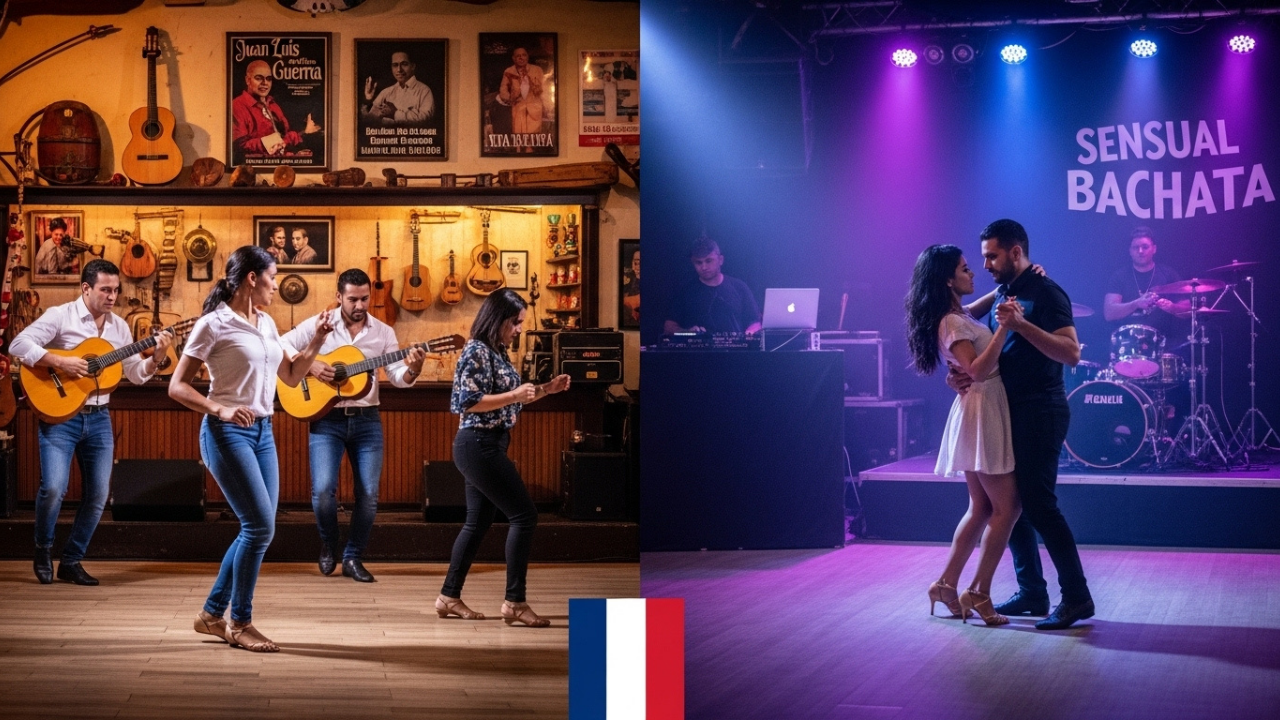
Movement is characterized by music. And perhaps nowhere is that evident more than in the opposition by Dominican and Sensual Bachata. The former is based on time-tested riffs of acoustic guitars, bright rhythms, and song narration. Consider such a famous Dominican musician as Juan Luis Guerra or Antony Santos whose music is emotional but rhythmically bright.
Sensual Bachata, in its turn, tends to be focused on slower and smoother tunes. Most of them are the remixes of pop music, R&B music, or urban Latin music. Here, it is all about the feeling and the flow of emotions, both in unison with the style of the body isolation and the intimacy between partners.
DJing in social dances in France is generally interchangeable, as DJs will revert between the two styles to please everyone there. This is an equilibrium of tastes—French fashion that is both traditional and innovative.
Technical Breakdown
The Movement of the Styles
What then are the differences in the way these styles can be danced?
Dominican Bachata:
-
Syncopated, footwork-intensive and scamper steps
-
Greater improvising dance posture
-
Choruses are short and they are usually linked with the rhythm strictly
-
Paired interaction is less tense and more talkative
Sensual Bachata:
-
Special attention should be paid to body movements: rolls, waves, isolations
-
Strong partner lead and follow feeling of a closed frame
-
Lower-paced tempos and dramatic breaks
-
Is often choreographed or conforms to previously learnt combinations
French dancers—especially those who are enrolled in a regular refined studio program—tend to learn Sensual Bachata as they find it stimulating to the eye. But the Dominican foundation is recommended to people seeking musicality and a stronger connection to rhythms.
The Reason Why France Adores the Two Styles
Diversity of the population and extensive artistic presence in France provide fertile soil to Dominican and Sensual Bachata. Dance schools, e.g. in Paris, are also teaching both styles—e.g. Baila Paris and Latin Groove Academy.
In the meantime, the people living in the overseas departments such as Guadeloupe and Martinique help in the maintenance of the Afro-Caribbean forms such as Dominican Bachata.
There is even the cultural aspect. There has been an even greater appreciation of multicultural encounters in French society, and dance—especially partner dance—is one such method of physically reaching out across the barricade of language and cultural backgrounds.
Here, the Dominican Bachata can represent authenticity and tradition in opposition to the Sensual Bachata which can be considered as a representation of artistic expression and modernity.
French Festivals and Socials: Bachata
The French have evolved into a hot spot (of sorts) of Latin dances in Europe, and there is always a Bachata show there. Dominican footwork or Sensual flow—you love it—the country is developing a wider choice of places that will satisfy your needs.
There is also the Paris Sensual Bachata Festival that takes place in Paris and attracts dancers as far as the other side of the globe to participate in it with the best of the best instructors and marathon socials that last into the wee hours of the morning. This festival has been characterized by intense Sensual Bachata and fusion workshops.
Nevertheless, Dominican Bachata tracks may be included in such festivals as Bachat’Love Marseille, Bachata Kizomba Paris, when the instructors dissect old Bachata steps, interpretation of music, and Bachata history. These songs appeal to learners who want to get closer to the traditions in the sphere of Afro-Caribbean.
The socials organized once a week in Paris, Lyon, and Montpellier are also diverse. You may begin it with a swing to an Antony Santos song and close it with a dramatic body bending to a DJ Tronky remix.
Studio Teachers in Action
This is partly due to the fact that both styles are extremely popular in France, whose dancing schools are quite a strong network. And the following are some notable breakthroughs:
Carlos & Chloe (Paris)
Carlos and Chloe continue to establish their reputation as Sensual Bachata masters with their classes at Latin Groove Academy that have a technical focus as well as emotional one.
Yoan & Emilie (Lyon)
This couple is the promoter of Dominican Bachata and runs periods of intense training sessions devoted to musicality.
Studio Harmonic (Paris)
Provides a line of fixed weekly classes in both Sensual and Dominican Bachata and gathers both novices and mature dancers.
Education is what puts the French dance scene to the fore. Numerous teachers organize monthly bootcamps, in which dancers have an opportunity to immerse entirely into one style. The cherry on top of it all was that: the practice to make dancers cross-train is encouraged by many studios, and it allows filling the gap between the two styles.
Student Views
Reasons That Make Them Prefer One to the Other
A what-comes-in-goes-out trend in conversations with French dancers of Bachata depicts a common theme of people being attracted towards what suits their personality.
Camille is a student in Toulouse, who says, “I started with Sensual Bachata because it was so pretty on Instagram. However, after realizing Dominican, playing it became interesting and melodious to me. Now I attempt to have a compound of the two.”
In the meantime, Nicolas, a dancer at the Parisian club, describes that, “Sensual Bachata fits my expression: it is like dance narrative with the body. I adore that it is so emotional.”
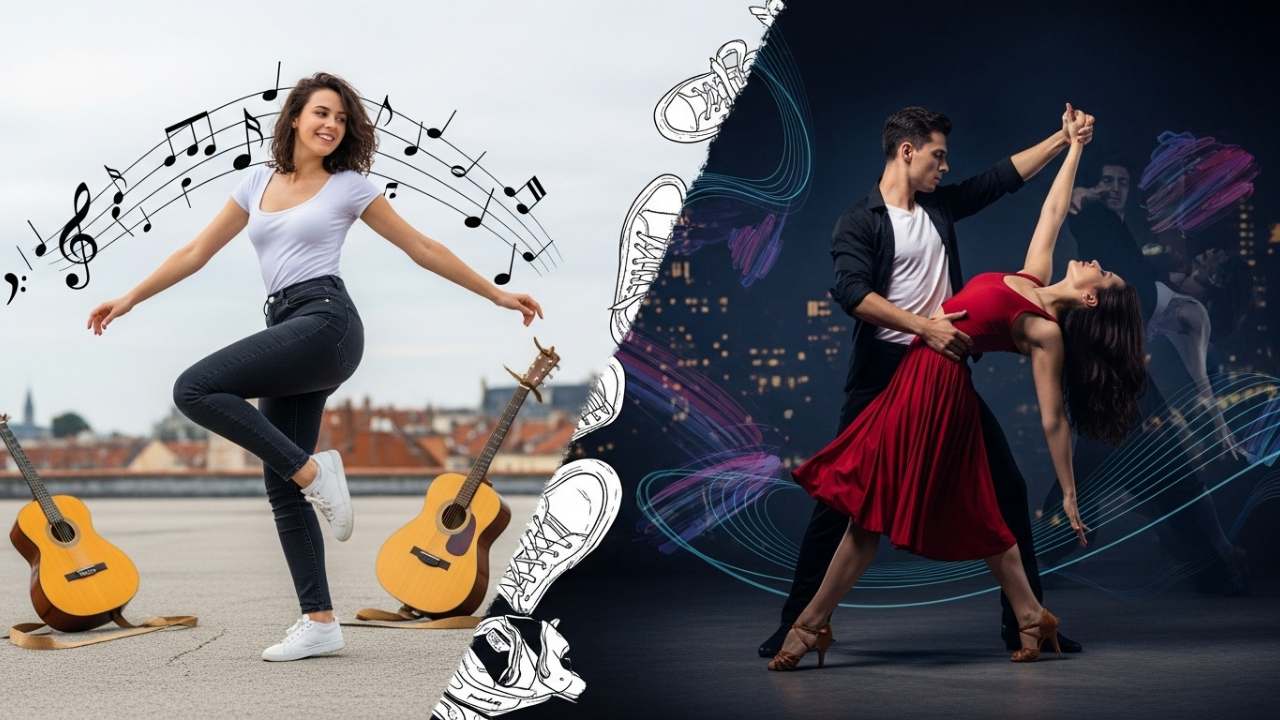
The key element is this alignment by oneself. Whereas Dominican Bachata attracts people who prefer rhythmic play and foot doings, Sensual Bachata is very attractive to dancers who love to dance by touch and sensual gestural beauty.
What Style Is Suitable to You?
Just starting out or wondering which to learn (I have my preferences, but it behooves me to tell you this)? Well, having started with Neverwinter Nights, I can simply give a basic comparison:
| Aspect | Dominican Bachata | Sensual Bachata |
|---|---|---|
| Musical Focus | Fast tempo, rhythm-heavy, traditional lyrics | Slow, dramatic, often remixes or pop influences |
| Movement Style | Quick footwork, improvisation, light steps | Body rolls, isolations, intense partner connection |
| Learning Curve | Musicality-focused, requires rhythm ear | Technique-heavy, requires strong body control |
| Social Experience | Light-hearted, playful, musical exchange | Intimate, expressive, visually dramatic |
| Cultural Connection | Rooted in Afro-Caribbean tradition | Modern European fusion with Latin roots |
What Style Is Suitable to You?
It has no right answer. Most of the French dancers first fall in love with any style and develop the other as they progress. The true happiness lies in trying out the two, though, and letting your body and personality take decisions.
Bachata: The Future in France
French Bachata does not seem to stop its momentum as we go deeper into 2025. New festivals, new teachers, and cross-style mixing have continued to perpetuate the culture and keep it creative. The use of social media has been massive in making young dancers be exposed to Sensual and Dominican style, and hybrid classes are increasingly gained.
The most exciting part is that dancers in France are starting to merge the two styles as they combine Dominican musicality and a Sensual technique. The effect is roundly French—air has been productive, healthy—but the outcome is something that is very French, which is rhythmic and yet fluid, traditional and yet daring.
As other dancers continue to experiment with this mash-up, France would stand a chance of becoming an international trend-setter, not only in terms of Bachata performance, but in Bachata innovation as well.
Summary
The French love affair with Bachata is a classical indicator of the beauty of cultural diversity of France and its obsessions with art. Maybe you are used to the complicated rhythm of the Dominican footwork or you flourish among the smooth rolls of Sensual movement, but the French dance floor will accommodate your form.
Whether you have or haven’t done it yet, take a class, take a swing at both styles, and go with the music. Bachata in France is not only the dance—it is also the dialogue between the cultures, generations, and the hearts. And you are welcome.