When we’re reminded of French cabaret, we often picture red velvet stages, feather fans, and sequined corsets. Paris — with the liveliness of its nightlife — has etched itself into pop culture memory through legendary names like Moulin Rouge and Paradis Latin, evoking elegance and a daring commitment to entertain.
Amid the burlesque routines, operatic interludes, and champagne-soaked charm, another art form quietly entered the stage and claimed a part in the limelight:
Belly dance.
An Unexpected Pairing
At first glance, this seems like an odd couple:
-
One is rooted in Middle Eastern and North African tradition
-
The other in European satire, sensuality, and theatrical rebellion
But Paris, a city built on reinvention, gave belly dance a space within its dazzling temples of attraction.
So how did belly dancing find its way into French cabaret?
How do these two dance forms coexist (or clash)?
And what does this tell us about cultural fusion in the performing arts?
Belly Dance’s Long Journey to the Parisian Stage
Before it reached velvet-lit stages and spotlight fame, belly dance lived in courtyards, rituals, and community festivals. Originating through a long lineage in Egypt, Turkey, Lebanon, and the Maghreb, it is known by its Arabic name: Raqs Sharqi.
These dances were never meant for the Western gaze or for clapping audiences. They were:
-
Spontaneous
-
Rhythmic
-
Deeply personal
-
Forms of emotional expression, sisterhood, fertility, and spiritual release
But when the West encountered belly dance — through colonial expeditions, Orientalist art, and world expos — the meaning began to shift.
The nuanced hip isolations, subtle arm gestures, and fluidity of movement were reinterpreted not as cultural language, but as exotic spectacle — a fantasy of eroticism and mystery.
Paris and the Birth of Cabaret Culture
Cabaret emerged in late 19th-century Paris as a hybrid art form — combining:
-
Song
-
Dance
-
Comedy
-
Political satire
Unlike traditional theater, cabaret thrived in intimate, smoky venues where people could drink, laugh, and question society in one night. It welcomed rebellion, sensuality, and female expression — not just beauty, but attitude.
Early clubs like Le Chat Noir and Moulin Rouge pioneered the form. They were open to eclectic acts:
Singers and poets shared the stage with acrobats, comedians, and eventually — risqué dancers.
The Arrival of the “Oriental” Fantasy
As colonial France expanded into the Middle East and North Africa, so did its appetite for “Oriental” themes. Soon, French cabaret was filled with:
-
Costumes inspired by the “Orient”
-
Music with Arabic motifs
-
Movements stylized to appear exotic
This was not authentic cultural expression, but rather a repackaging for Western tastes. Belly dance, dubbed danse du ventre (“dance of the stomach”), was imported not as a respected tradition, but as a fantasy — something seductive, mysterious, and foreign.
The First Time Belly Dance Appeared on the Cabaret Stage
The earliest known performances of belly dance in Paris date back to the 1889 Exposition Universelle, a major world fair where foreign cultures were displayed — part exhibition, part spectacle.
Algerian and Egyptian dancers performed in their traditional ways. But the integrity of the form didn’t last long. It was quickly adapted, accelerated, and stylized into something more theatrical and palatable to French cabaret tastes.
Before long, these dancers — or forms of them — began appearing in cabaret performances. The movements were still there, but the context shifted:
-
They danced not at weddings or sacred rituals
-
But for applause, on Parisian stages
-
Their art was no longer part of a living cultural tradition
-
It became a visual backdrop to a Parisian event
This marked the first fusion of belly dance and cabaret — a meeting point of artistic and cultural remodeling.
Meeting Place: What Babydoll and Belly Dance Have in Common
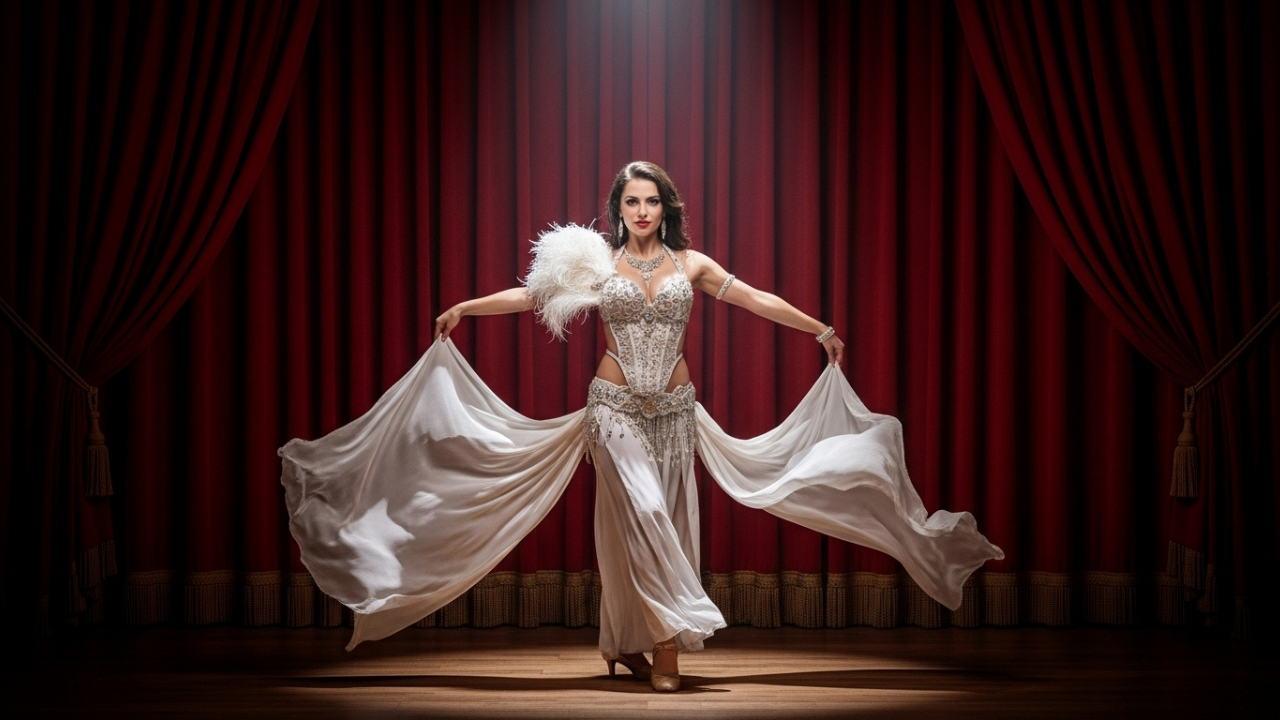
At first glance, cabaret and belly dance seem worlds apart. But look more closely, and you’ll find shared values in how the body is used as both instrument and canvas:
Sensuality
Both styles celebrate curves, fluidity, and emotional movement. Neither is purely about spectacle — both can carry emotional charge.
Solo Expression
These dances are often performed solo, spotlighting a dancer’s personal presence and interpretation.
Costume as Language
Whether it’s a shimmering bedlah or a feathered corset, both forms use wardrobe as rhythm — articulating motion, accentuating musicality, telling story through detail.
Audience Interaction
These are not distant performances. Both forms invite intimacy, sometimes breaking the “fourth wall” entirely. Connection, not separation, is the goal.
Done well, a belly dance performance in a French cabaret does not imitate — it reinvents. It becomes a storytelling scene, draped in silk and sequins.
Where They Collide: The Danger of Decontextualization
Still, not all cabaret interpretations of belly dance are respectful.
Belly dance is an ancient tradition — an embodied oral history of women passed down over generations. It’s grounded in:
-
Cultural rhythm structures
-
Social rituals
-
Spiritual practice
-
Community storytelling
When this context is removed, belly dance risks being reduced to a sensual showpiece, losing its voice and substance.
Cabaret, by contrast, was built to entertain and provoke, not to preserve culture. It thrives on artistic freedom — a principle that is justified, but not without cost.
At times, that freedom has led to shallow, glittery portrayals of belly dance — where veils and hips are props, and tradition becomes costume.
The Critical Questions We Must Ask
This tension invites us to ask important questions, especially in a city like Paris where both art and identity are constantly being performed:
-
By placing belly dance in a Parisian revue, whose story is being told?
-
Is the audience witnessing a cultural tribute — or a fashionable imitation?
-
Do the performers know the tradition — or have they only been trained to mimic it?
These questions are not merely rhetorical.
They echo through the studios, cabarets, and showrooms of Paris today — where the line between celebration and appropriation is still being drawn.
Exotic Gaze and Orientalism in French Cabaret
You can’t talk about belly dancing in French cabaret without addressing the exotic gaze — and specifically, the role of Orientalism.
The term Orientalism was introduced by scholar Edward Said, describing the paternalistic and reductive ways in which the Western world imagined “Eastern” cultures — often exotic, mysterious, and inferior.
In the context of French cabaret, this translated into persistent, oversimplified tropes such as:
-
Harem fantasies
-
Snake charmers
-
Submissive seductresses disguised as belly dancers
These archetypes became standard features in:
-
Poster art
-
Early 20th-century films
-
Marketing materials for Parisian cabarets
They were highly effective in selling tickets — but also deeply effective in shaping stereotypes.
When Diversity Was Replaced by Fantasy
Rather than celebrating the rich diversity of Middle Eastern and North African dance traditions, French cabaret often collapsed all forms into one stylized image:
-
Veils
-
Jewels
-
Mystery and mystique
The woman became an icon — not a person. A decorative motif, not a dancer with her own cultural story.
This kind of portrayal stripped belly dance of its context, replacing meaning with spectacle.
Nevertheless, Real Artists Emerged
Even in this atmosphere, authentic performers found ways to break through.
Some dancers challenged the tropes.
Some embedded genuine technique, cultural symbolism, and personal expression into cabaret stages, even within a restrictive system.
These artists laid the groundwork for a newer generation of dancers — ones who now blend tradition with innovation while being mindful of representation.
Parisian Cabaret Today: Where to Watch Belly Dance
In modern-day Paris, the cabaret landscape is far more complex and layered.
Yes, some venues still include belly dance in their revues — but the intent and presentation vary widely. Some shows lean toward sensationalism, while others embrace authentic storytelling and artistry.
In the more conscious venues, belly dance is framed not as a caricature, but as narrative performance — where the dancer holds space, and cultural respect is central to the act.
| Venue Name | Neighborhood | Show Style | Frequency | Booking Info |
|---|---|---|---|---|
| Crazy Horse Paris | 8th Arrondissement | Neo-burlesque + Oriental fusion | Nightly Shows | [Link Placeholder] |
| Paradis Latin | Latin Quarter | Traditional Cabaret with belly dance features | Weekly Shows | [Link Placeholder] |
| Bel Canto | Marais | Dinner + Cabaret with ethnic dance features | Weekend Shows | [Link Placeholder] |
When it comes to attending cabaret shows in Paris that include belly dance, it pays to do a little research ahead of time.
Some performances are deeply cultural, presented by trained individuals with cultural knowledge and respect.
Others, unfortunately, revert to old stereotypes — reducing belly dance to a hollow exotic image. Being an informed viewer makes all the difference.
Outstanding Leaders Who Bridged the Divide
While many dancers were misrepresented or co-opted, some remarkable women carved out space on their own terms:
Josephine Baker
Though not a belly dancer by training, she engaged with the language of exoticism in a way that became a critique. Her performances were acts of protest, using her body and stage as both weapon and expression.
Badia Masabni
An Egyptian pioneer who introduced cabaret-style belly dance to the Middle East. Though not directly Parisian, her reimagining of Raqs Sharqi for the stage influenced how belly dance was perceived worldwide — including in Parisian revues.
A New Chapter: Arab and North African Artists Reclaiming the Stage
In recent decades, diaspora artists in France — particularly Middle Eastern and North African women — have begun to reclaim cabaret spaces, telling their own stories.
They are choreographing resistance, not caricature.
They are reviving belly dance as a language of power, narrative, and identity.
The Belly Dance Renaissance in a New Paris
Visit a Parisian cabaret today and you may be surprised.
Though feather boas and sequined gloves still exist, many shows have evolved into platforms for multicultural storytelling, blending global rhythms with modern aesthetics.
Belly dance has not been left behind — it has been:
-
Reclaimed
-
Reframed
-
Reimagined
Modern dancers — especially those from the cultures where belly dance originates — now tell their own stories, shifting the audience’s perception from fantasy to authenticity.
Fusion or Confusion? The Fine Line in Contemporary Cabaret
Contemporary cabaret often thrives on fusion — a single act might pass through flamenco, jazz, and belly dance in minutes.
Done well, this kind of genre-mixing is exciting and innovative.
Done poorly, it strips meaning, turns tradition into props, and contributes to cultural deconstruction.
Where’s the line?
Fusion is successful when:
-
It is well-researched
-
The mix is reverent
-
The dancer has cultural awareness or training
It fails when performers mimic superficial movements with no connection to their roots. Sadly, this still occurs in many Paris venues.
The Role of Choreographers and Viewers
Some cabaret choreographers now collaborate with cultural consultants or train with North African and Levantine masters.
Others, however, fall into Orientalist traps, treating belly dance as a visual gimmick.
-
Viewers must learn to observe critically
-
Dancers must speak up when their traditions are misused
Voices of the Parisian Diaspora
One of the most profound transformations in Paris cabaret has been the rise of Arab and North African performers who share lived experience — not imagined fantasy.
Examples:
-
Siham, a French-Moroccan performer in Montreuil, who blends Amazigh rhythms with spoken word poetry
-
Layla Nour, an Egyptian-born Parisian artist who performs monthly shows that explore the roots of Raqs Sharqi in a modern political context
These women — and many others — are reclaiming their space and their stories.
They don’t just dance — they teach, provoke, and inspire.
Their performances explore themes like:
-
Belonging and identity
-
Cultural appropriation and harm
-
Dancing as ancestral memory
-
Female empowerment amid colonial and patriarchal legacies
By combining classical movement with contemporary commentary, they elevate belly dance into a political performance, without losing its aesthetic beauty.
Traditional Belly Dance vs. Cabaret-Style Belly Dance: A Discussion
As belly dance continues to develop on Parisian stages, it’s important to understand the differences between traditional and cabaret-style forms — not to rank them, but to respect their distinct purposes and expressions.
Traditional vs. Cabaret-Style Belly Dance in Paris
| Aspect | Traditional Belly Dance | Cabaret-Style Belly Dance |
|---|---|---|
| Cultural Roots | Deeply connected to regional identity | Often decontextualized or stylized |
| Setting | Weddings, festivals, private gatherings | Nightclubs, revue shows, big stages |
| Costume Style | Modest, regional garments or bedlah | Sequins, feathers, high-slit skirts |
| Movement Intent | Internal, spiritual, emotionally expressive | External, performative, theatrical |
| Music | Live, traditional instruments | Remixed or modern orchestrations |
| Audience Role | Part of the celebration or ritual | Passive spectators, entertained |
| Dancer’s Voice | Autonomous, culturally embedded | Often directed by choreographer/show |
Awareness, Not Judgment: Understanding Form and Intention
This is neither good nor bad.
It’s a question of awareness — of what each form wishes to achieve, and where it risks slipping into misrepresentation. Understanding intention is what separates artful fusion from cultural distortion.
Cabaret Schools and Cultural Studios: Two Paths to Learning Belly Dance in Paris
In Paris, belly dance can be studied through two very different educational approaches:
Cabaret Workshops & Schools
These programs focus on:
-
Performance and styling
-
Stage presence and costume design
-
Lighting interaction
-
Integrating belly dance within broader cabaret, burlesque, or jazz acts
The emphasis is often on theatricality and polished visual appeal — perfect for dancers entering the performance circuit.
Cultural Dance Studios
These schools prioritize:
-
Technical authenticity
-
Musicality and Arabic rhythms
-
Folkloric and regional styles, like Saidi, Baladi, or Turkish Romani
Students receive deep cultural grounding, learning not just the moves but why and where they come from.
The Hybrid Option: A Path Forward
Studios such as Amani Studio and Studio LAX Paris now offer both tracks, allowing students to explore belly dance from:
-
An artistic perspective, and
-
A cultural one
This juxtaposition is shaping a new generation of performers who understand the source of what they bring to the stage.
Is There Room in Glamorous Cabaret for Traditionalists?
Yes — and it’s growing.
Cabaret does not have to mean caricature.
When directors and dancers collaborate with integrity, cabaret becomes a shared space, not a spectacle of cultural reduction.
Some Paris establishments now host ethnic nights — performances that showcase traditional dance in its purest form, with no feathers, no distortion.
Others produce collaborative shows that feature diaspora musicians, poets, and dancers side by side — blending roots with innovation.
It’s not about diluting cabaret.
It’s about elevating it — making room for all that built it.
How to Promote Wholesome Belly Dance in Paris
Whether you’re a tourist, audience member, or aspiring dancer, your choices shape the scene. Here’s how you can support belly dance responsibly:
1. Investigate Your Shows
Research the artists. Ask how the performance connects to cultural context. Look for shows that honor, not imitate.
2. Attend Cultural Festivals
Many festivals feature authentic belly dance performances grounded in cultural practice.
3. Support the People
Follow diaspora dancers. Subscribe to their work, take their classes, and amplify their voices.
4. Ask Questions
Ask performers and cabaret directors about their influences and intentions. Don’t be afraid to dig deeper.
5. Learn From the Source
If you’re learning to dance, seek out teachers who live the culture, not just perform it.
Summary: Paris, Belly Dance, and the Power of Story
Belly dance in French cabaret is not just a show —
It’s a discourse.
A living dialogue between:
-
East and West
-
Past and future
-
Identity and fantasy
Paris, the city that adores spectacle and reinvention, has never been barren ground for artistic intermixing. But today, that fusion is becoming more:
-
Experienced
-
Inclusive
-
Self-aware
Whether you’re watching a dancer twirl beneath red velvet lights,
Or taking your first hip shimmy class on the Left Bank —
You’re witnessing more than just movement.
You’re witnessing history, resistance, and evolution —
all set to the timeless beat of eight counts.